Your input will help us improve your experience.You can close this popup to continue using the website or choose an option below to register in or log in.
Art and design degrees can sometimes be perceived as solely reserved for those with a traditional creative background, but this really isn’t the case.
The Royal College of Art (RCA) in the United Kingdom stands out as a beacon of inclusivity, inviting students to its postgraduate programmes from less traditionally creative backgrounds who can bring unconventional expertise into the next generation of creative leadership.
To learn more about the opportunities available to students, we spoke to three RCA students about their experiences and how they made the switch to pursue a career in art and design.
Xavier Laurent-Leopold
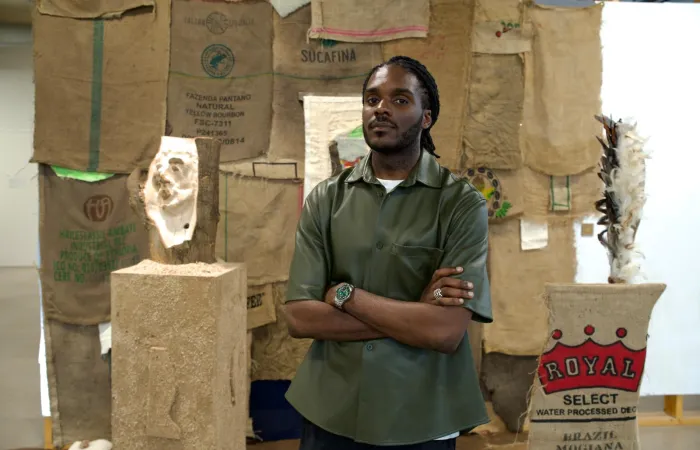
Formerly a City trader in asset management, Xavier was a Sir Frank Bowling Scholar at the Royal College of Art, where he has completed an MA in Sculpture.
Can you tell us a bit about your journey towards being an artist?
Before becoming an artist, I worked as a trader in the financial sector in the City of London.
It was a fast environment, always chasing the next thing, and in that process a lot of personal experiences and emotions were pushed to the side.
Going into lockdown, when everything slowed down, a lot of that began to come back up. Around that time, I was in therapy, and I’d find myself doodling on whatever was around. I bought a few small canvases and some paints, and started expanding on those doodles, almost like colouring them in, but giving them more space.
From there, it slowly became something more. I began to see the effect it was having on me, how it helped me explore parts of myself I hadn’t really faced before.
What inspired you to apply to RCA in particular?
I never originally set out to go to art school. My relationship with art started in a very personal way, so for a while I was just developing my practice independently and following where it was taking me.
Over time, that shifted. What began as something I was doing for myself started to feel like a real sense of purpose, almost like something I had a responsibility to commit to properly.
Applying to RCA felt like a deliberate decision to challenge myself, to step into an environment where I could refine my thinking, push my materials further, and be surrounded by artists who were equally committed to their practice.
What drew me to RCA was the intensity of that environment. The conversations, the facilities, and the calibre of people all felt like something that would stretch me beyond what I could achieve on my own.
How has your City background influenced the art you create?
My time in the City has definitely shaped how I work, probably more than I realised at first. Being a trader teaches you discipline, structure, and how to make decisions under pressure, and that’s something I’ve carried into the studio.
It’s also influenced how I think through my work. I tend to work quite reflectively, sometimes even backwards, looking at different variables, fragments, and references, and piecing them together into a bigger picture.
It’s not too far from how you’d read a market, identifying patterns, sensing shifts, and building an understanding over time.
What skills do you believe have been transferable from your background in asset management?
More on the practical side than I expected. Discipline is a big one. In asset management you have to be consistent, manage your time well, and stay focused, and that’s exactly the same in the studio.
On a master's in art, you are not chased or monitored like you are in the City, so you have to set your own structure.
Organisation has also been important. Managing multiple projects, deadlines, and commitments is something I was used to before, and it’s helped me balance my practice alongside everything else that comes with it.
I’d also say communication. Being able to speak clearly about what you’re doing, whether that’s to collectors, collaborators, or institutions, makes a big difference.
And then resilience. You get used to things not always going your way in the City, and that carries over. You learn to stay level, keep going, and not take every setback too personally.
Why should other applicants from a ‘business’ background consider an MA at RCA?
Coming from a business background, you’re often used to operating in a structured, analytical way. Doing an MA at RCA gives you the chance to engage the other side of your brain, to think more creatively, intuitively, and openly, and to let those two ways of thinking sit alongside each other.
For me, it wasn’t about leaving one world behind but expanding it. It also puts you in an environment with people from completely different walks of life, which challenges you in a good way. You’re constantly exposed to new perspectives and approaches that you wouldn’t necessarily encounter otherwise.
What prompted your transition from dance to other art forms?
Before entering the RCA, I worked for several years in Japan as a professional ballroom dancer. Through dance, I became deeply interested in how the body draws invisible lines in space, and how a single movement can transform the atmosphere and emotional tone of a place.
Gradually, my curiosity expanded beyond choreography itself to include the environment surrounding the body. I began exploring performance art, spatial design, and wearable costume design, seeking ways to investigate the relationship between body and space from multiple perspectives.
What attracted you to studying Information Experience Design at the RCA?
I was strongly drawn to its experimental environment that does not confine itself to a single discipline. As someone searching for a space where I could move fluidly between performance, installation, digital media, sound, and research, the programme felt like a very natural choice.
The cohort brings together students from a wide range of backgrounds – including physics, mathematics, law, music, graphic design, and animation – allowing diverse perspectives and research methods to intersect.
How did the programme change your approach to creating art?
The programme significantly changed the way I think about making work. Previously, I often approached a piece through a single medium. At the RCA, however, I began to see a project as a network of relationships among materials, technology, bodies, environments, and audiences.
My sense of scale and materials also expanded. I became interested in working at much larger spatial scales, such as outdoor public sculptures or installations that engage entire temples or historical buildings.
Through collaboration with engineers and scientists, I also began to treat technologies such as sensors, algorithms, and AI as materials, in the same way as metal, fabric, light, or sound.
Patrick Turner-Lee
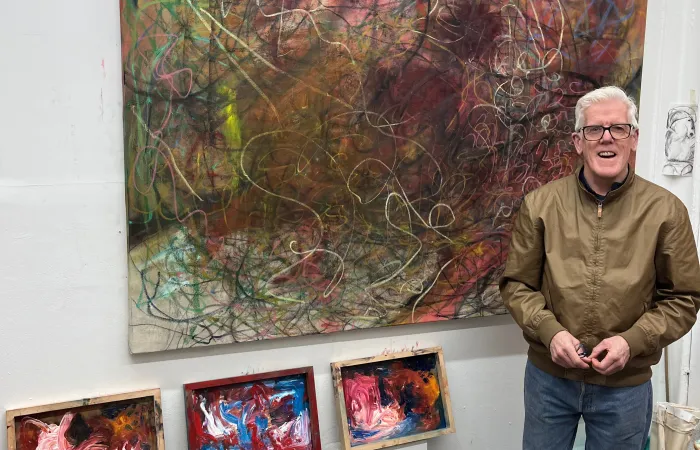
Patrick is a Brighton-based artist who made the transition to art having previously worked in operations for Royal Mail. Patrick is now a Painting MA student at RCA.
Can you tell us a bit about your journey towards being an artist.
I actually suffered a heart attack a few years ago and while I was recovering, I started to draw. Soon after I managed to get a studio in Brighton. My past work experience helped me become a self-employed sole trader and I started to sell some paintings.
How does your previous career impact the way you approach your art?
As an operations manager the part I did enjoy was solving immediate problems. As my painting practice progresses, I am constantly seeing problems that need to be embraced. What to paint, with what medium, why and how? When I start a painting, I might have an idea what to do but this changes, grows and develops.
What were the factors that convinced you art was something worth pursuing academically?
In 2024, with help from an RCA graduate, I secured Arts Council Funding to do a project around deafness and ADHD. During the time that I was making the paintings for this project the same person suggested I apply for an MA.
At first, I thought the idea was crazy. When I considered my age, I decided it is now or never. I knew from the outset this was not a hobby but a necessity.
What aspects of the course at RCA were most enlightening?
The Painting MA is particularly egalitarian and really concentrates on painting on a deep and rigorous level. I was very nervous about going into education, not only because I have high hearing loss and neuro-divergent symptoms.
I am really amazed at the progress I am making and the trajectory my work has taken. To be with students from all over the globe in a learning environment is better than any medical solution to older age. I have gained a lot of understanding of the art world as it is today and a deeper understanding of my own position in the world.
As Head of Content, Craig is responsible for all articles and guides published across TopUniversities and TopMBA. He has nearly 10 years of experience writing for a student audience and extensive knowledge of universities and study programs around the world.
Adelaide offers a safe, welcoming, and culturally diverse community on the coast, embodying all the best of Australia. Here’s why this South Australian gem should be at the top of your university wish list.
What happens when you choose a study destination for growth, not just reputation? Anne’s journey shows how one bold decision can shape your entire career.
Views
Why art & design degrees are for students from any background
Save
Share
Share via
Share this Page12
Table of contents
Table of contents
Sponsored by Royal College of Art
Art and design degrees can sometimes be perceived as solely reserved for those with a traditional creative background, but this really isn’t the case.
The Royal College of Art (RCA) in the United Kingdom stands out as a beacon of inclusivity, inviting students to its postgraduate programmes from less traditionally creative backgrounds who can bring unconventional expertise into the next generation of creative leadership.
To learn more about the opportunities available to students, we spoke to three RCA students about their experiences and how they made the switch to pursue a career in art and design.
Xavier Laurent-Leopold
Formerly a City trader in asset management, Xavier was a Sir Frank Bowling Scholar at the Royal College of Art, where he has completed an MA in Sculpture.
Can you tell us a bit about your journey towards being an artist?
Before becoming an artist, I worked as a trader in the financial sector in the City of London.
It was a fast environment, always chasing the next thing, and in that process a lot of personal experiences and emotions were pushed to the side.
Going into lockdown, when everything slowed down, a lot of that began to come back up. Around that time, I was in therapy, and I’d find myself doodling on whatever was around. I bought a few small canvases and some paints, and started expanding on those doodles, almost like colouring them in, but giving them more space.
From there, it slowly became something more. I began to see the effect it was having on me, how it helped me explore parts of myself I hadn’t really faced before.
What inspired you to apply to RCA in particular?
I never originally set out to go to art school. My relationship with art started in a very personal way, so for a while I was just developing my practice independently and following where it was taking me.
Over time, that shifted. What began as something I was doing for myself started to feel like a real sense of purpose, almost like something I had a responsibility to commit to properly.
Applying to RCA felt like a deliberate decision to challenge myself, to step into an environment where I could refine my thinking, push my materials further, and be surrounded by artists who were equally committed to their practice.
What drew me to RCA was the intensity of that environment. The conversations, the facilities, and the calibre of people all felt like something that would stretch me beyond what I could achieve on my own.
How has your City background influenced the art you create?
My time in the City has definitely shaped how I work, probably more than I realised at first. Being a trader teaches you discipline, structure, and how to make decisions under pressure, and that’s something I’ve carried into the studio.
It’s also influenced how I think through my work. I tend to work quite reflectively, sometimes even backwards, looking at different variables, fragments, and references, and piecing them together into a bigger picture.
It’s not too far from how you’d read a market, identifying patterns, sensing shifts, and building an understanding over time.
What skills do you believe have been transferable from your background in asset management?
More on the practical side than I expected. Discipline is a big one. In asset management you have to be consistent, manage your time well, and stay focused, and that’s exactly the same in the studio.
On a master's in art, you are not chased or monitored like you are in the City, so you have to set your own structure.
Organisation has also been important. Managing multiple projects, deadlines, and commitments is something I was used to before, and it’s helped me balance my practice alongside everything else that comes with it.
I’d also say communication. Being able to speak clearly about what you’re doing, whether that’s to collectors, collaborators, or institutions, makes a big difference.
And then resilience. You get used to things not always going your way in the City, and that carries over. You learn to stay level, keep going, and not take every setback too personally.
Why should other applicants from a ‘business’ background consider an MA at RCA?
Coming from a business background, you’re often used to operating in a structured, analytical way. Doing an MA at RCA gives you the chance to engage the other side of your brain, to think more creatively, intuitively, and openly, and to let those two ways of thinking sit alongside each other.
For me, it wasn’t about leaving one world behind but expanding it. It also puts you in an environment with people from completely different walks of life, which challenges you in a good way. You’re constantly exposed to new perspectives and approaches that you wouldn’t necessarily encounter otherwise.
Maki Takato
Maki is a former dancer turned multidisciplinary artist and an Information Experience Design MA graduate.
What prompted your transition from dance to other art forms?
Before entering the RCA, I worked for several years in Japan as a professional ballroom dancer. Through dance, I became deeply interested in how the body draws invisible lines in space, and how a single movement can transform the atmosphere and emotional tone of a place.
Gradually, my curiosity expanded beyond choreography itself to include the environment surrounding the body. I began exploring performance art, spatial design, and wearable costume design, seeking ways to investigate the relationship between body and space from multiple perspectives.
What attracted you to studying Information Experience Design at the RCA?
I was strongly drawn to its experimental environment that does not confine itself to a single discipline. As someone searching for a space where I could move fluidly between performance, installation, digital media, sound, and research, the programme felt like a very natural choice.
The cohort brings together students from a wide range of backgrounds – including physics, mathematics, law, music, graphic design, and animation – allowing diverse perspectives and research methods to intersect.
How did the programme change your approach to creating art?
The programme significantly changed the way I think about making work. Previously, I often approached a piece through a single medium. At the RCA, however, I began to see a project as a network of relationships among materials, technology, bodies, environments, and audiences.
My sense of scale and materials also expanded. I became interested in working at much larger spatial scales, such as outdoor public sculptures or installations that engage entire temples or historical buildings.
Through collaboration with engineers and scientists, I also began to treat technologies such as sensors, algorithms, and AI as materials, in the same way as metal, fabric, light, or sound.
Patrick Turner-Lee
Patrick is a Brighton-based artist who made the transition to art having previously worked in operations for Royal Mail. Patrick is now a Painting MA student at RCA.
Can you tell us a bit about your journey towards being an artist.
I actually suffered a heart attack a few years ago and while I was recovering, I started to draw. Soon after I managed to get a studio in Brighton. My past work experience helped me become a self-employed sole trader and I started to sell some paintings.
How does your previous career impact the way you approach your art?
As an operations manager the part I did enjoy was solving immediate problems. As my painting practice progresses, I am constantly seeing problems that need to be embraced. What to paint, with what medium, why and how? When I start a painting, I might have an idea what to do but this changes, grows and develops.
What were the factors that convinced you art was something worth pursuing academically?
In 2024, with help from an RCA graduate, I secured Arts Council Funding to do a project around deafness and ADHD. During the time that I was making the paintings for this project the same person suggested I apply for an MA.
At first, I thought the idea was crazy. When I considered my age, I decided it is now or never. I knew from the outset this was not a hobby but a necessity.
What aspects of the course at RCA were most enlightening?
The Painting MA is particularly egalitarian and really concentrates on painting on a deep and rigorous level. I was very nervous about going into education, not only because I have high hearing loss and neuro-divergent symptoms.
I am really amazed at the progress I am making and the trajectory my work has taken. To be with students from all over the globe in a learning environment is better than any medical solution to older age. I have gained a lot of understanding of the art world as it is today and a deeper understanding of my own position in the world.
Learn more
The RCA is the world’s number one ranked art and design university, and has been for 12 years in a row (2015-2026).
This prestige does not mean exclusivity and the RCA recognises the value that diversity of experience, expertise and culture brings.
If this article has got you interested, find out more about the Royal College of Art, visit our website.
As Head of Content, Craig is responsible for all articles and guides published across TopUniversities and TopMBA. He has nearly 10 years of experience writing for a student audience and extensive knowledge of universities and study programs around the world.
Recommended Articles Last year
Greek universities at a glan…
Learn more about the different universities located in Greece and their various strengths.
5 reasons to choose Adelaide…
Adelaide offers a safe, welcoming, and culturally diverse community on the coast, embodying all the best of Australia. Here’s why this South Australian gem should be at the top of your university wish list.
How studying abroad in Sri L…
What happens when you choose a study destination for growth, not just reputation? Anne’s journey shows how one bold decision can shape your entire career.